
Chess Improvement
The Best AI Chess Coaches in 2026 (and How to Spot the Slop)
Published , updated
Short answer: it depends on the job. For fixing the mistakes you keep making, KingChess. For an all-in-one talking coach, Chessigma. For free analysis, Lichess. For human-like sparring, Maia. Whatever you pick, check that an engine backs every claim the coach makes.
In the last two years, every chess app on earth added the letters "AI" to its landing page. Some of these tools are genuinely useful. Some are a ChatGPT prompt wearing a trench coat. If you are trying to pick one, the marketing will not help you, because it all sounds identical.
So here is an honest guide, organized by what you are actually trying to fix. One disclosure up front: KingChess is our product. You know where we stand. In exchange, we will tell you plainly when a rival is the better pick, because a comparison page that crowns itself in every category is exactly the slop this article is about.
First, how to spot AI slop
Large language models are spectacular at sounding like a chess coach and terrible at being one. Ask a general chatbot to analyze your game and you will get confident, fluent, plausible analysis that falls apart the moment you check it. LLMs still suggest illegal moves, invent variations that never happened, and praise "strong positional play" in positions where you are down a rook.
That is the core problem with a wave of new "AI chess coach" apps: they are thin wrappers around a text generator. The words are generated first and checked never.
The test is simple. For any claim an AI coach makes, ask: where did this come from? A real tool computes the truth first, with a chess engine and your actual games, and only then puts words on it. If the tool cannot show you the move, the line, and the position behind its advice, close the tab.
To be clear, KingChess uses AI language too. Our coach talks. The difference is what he is allowed to say: every claim starts as an engine evaluation or a detected tactic, and the AI only phrases it. The words can be friendly. The facts are not negotiable.
Best for fixing the mistakes you actually make: KingChess
This is us, and this is the specific job we built for. KingChess takes your Chess.com or Lichess username, finds where you actually blundered in your recent games, and names the habit behind the blunders: hanging pieces, collapsing from equal positions, giving back winning positions, falling apart in the endgame.
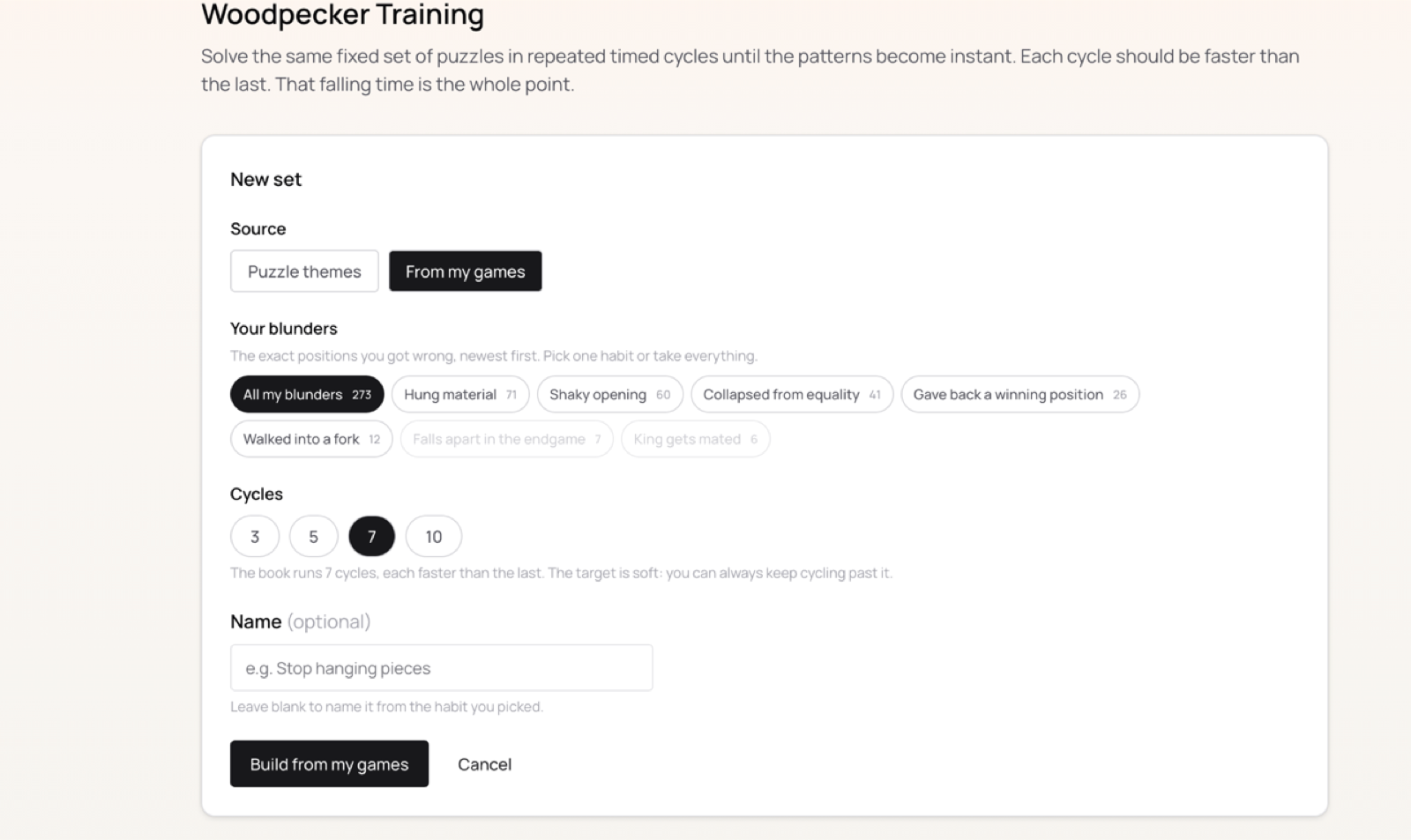
Then it makes you fix them. Every blunder becomes a puzzle from the exact position you got wrong, brought back on a spaced repetition schedule until the pattern sticks. You can also build a Woodpecker set out of your own mistakes, all of them or just one habit, and grind it in timed cycles. Game reviews come with a coach who explains your mistakes in plain words, and you can ask him about any move you do not understand. His name is Bjorn. He is a polar bear. Long story. On Premium he also writes a longer note on each mistake and reads it out loud.
Who it is not for: if you want deep opening preparation or a sparring partner, that is not our lane. KingChess is narrow on purpose. It exists because most games below 1400 are lost to repeated blunders, not to strategy, and almost nothing else on this list attacks that directly.
It is free to try, no signup needed, and you will see your own patterns in about a minute.
Want to run the slop test on us first? Paste a game into the free blunder check. It draws Stockfish's move next to yours, and Bjorn names the tactic behind it.
Best all-in-one talking coach: Chessigma
Chessigma is the polished generalist of the new wave, and we say that as a competitor. You get game review with a coach that talks through your moves, plus a broad set of tools around it. If you want one app that covers review, explanation, and general training in a single place, it is a good pick, and it is clearly built by people who take the hallucination problem seriously.
The difference is focus. Chessigma reviews the game in front of you. KingChess is more single-minded: it aggregates your mistakes across all your games, names the habits, and drills you on them until they go away. Review versus rehab.
Best free analysis: Lichess
Not new, not marketed as AI, still unbeatable at what it does. Lichess gives you Stockfish analysis in the browser, an opening explorer, studies, and practice tools, all free and open source. If you have the discipline to review your own losses honestly, Lichess plus a notebook is a legitimate improvement plan that costs nothing.
The catch is the discipline. Lichess shows you what went wrong and leaves the rest to you. It will not name your habits, will not bring a mistake back next week to check you actually learned it, and will not stop you from queuing the next game instead of looking at the loss.
Best human-like sparring: Maia
Most engine bots are useless to practice against because they play alien chess badly on purpose. Maia is different: a neural network trained on millions of human games at each rating level, so the 1200 bot blunders the way a real 1200 blunders. Playing against it, on Lichess for free, is the closest thing to a realistic online opponent that never tilts and never runs out of games.
Just know what it is. Maia is a sparring partner, not a coach. It will punish your mistakes realistically and explain none of them.
What about Chess.com's Game Review?
Convenient, on the platform you already play on, and the coach explanations have gotten genuinely decent. For a quick "what just happened" after a game, it is fine, and for many casual players it is enough.
Its limit is memory. Each review lives and dies with that one game. It will tell you that you hung a knight today. It will not tell you that you have hung a piece 71 times in three months and that it is the single habit costing you the most rating, because connecting your mistakes across games is not what it is for.
The short version
| Tool | Best for | Engine-backed | Drills your own mistakes |
|---|---|---|---|
| KingChess | Fixing your recurring blunders | Yes | Yes, that is the whole point |
| Chessigma | All-in-one talking review | Yes | No, reviews per game |
| Lichess | Free analysis, self-directed study | Yes | No, you do the work |
| Maia | Realistic sparring | It is the model | No, it just beats you honestly |
| Chess.com Review | Quick post-game check | Yes | No, one game at a time |
| General chatbots | Nothing chess-related | No | No, and it will invent moves |
How to actually choose
Ignore the feature lists and start from your problem.
- You keep losing and do not know why. You need something that reads your own games and names the pattern. That is KingChess, or Lichess plus real discipline.
- You are great at puzzles but lose real games. Random puzzles are the problem, not the solution. Here is why, and why drilling your own positions fixes it.
- You want one app for everything. Chessigma is the strongest generalist right now.
- You want realistic practice games. Maia, free on Lichess.
- You want to spend nothing. Lichess, and mean it about reviewing your losses.
Frequently asked questions
Can ChatGPT coach chess?
No. It can explain general concepts and chess history well, but it cannot reliably analyze positions. It suggests illegal moves and invents evaluations, delivered with total confidence. Use tools where an engine does the chess and the AI only does the talking.
Is using an AI chess coach cheating?
Between games, no. Reviewing finished games with an engine or a coach is how everyone improves, from beginners to super grandmasters. During a game, yes, always. Any tool that suggests moves while you play will get your account banned, and it should.
Do AI chess coaches actually work?
The good ones work because the ingredients were never magic: engine-checked truth about your games, repetition until patterns stick, and enough friendliness that you actually keep showing up. The AI part done right makes the truth easier to hear. Done wrong, it replaces the truth entirely. That is the whole slop test.
What is the difference between a chess engine and an AI coach?
An engine tells you the best move. A coach tells you why your move was worse, in words you can use in your next game, and remembers what you keep getting wrong. Stockfish is a perfect witness and a terrible teacher. The point of a coach is translation.
See the mistakes costing you rating
KingChess turns your real blunders from Chess.com or Lichess into puzzles you drill until the pattern sticks. Free, no signup needed.
Try KingChess free