
Chess Improvement
What Is the Woodpecker Method in Chess (and How to Actually Use It)
Published
You already know tactics matter, so you grind puzzles, hundreds of them, and yet you still miss the same forks and hang the same pieces in real games. If that sounds familiar, the problem probably is not how many puzzles you do. It is how you do them. The Woodpecker Method is a training system built to fix exactly that, and it is one of the most respected approaches to tactics out there.
What is the Woodpecker Method?
The Woodpecker Method comes from a book of the same name by Axel Smith and Hans Tikkanen, a grandmaster who credited the technique for a big rating jump. The idea is almost stupidly simple: instead of solving new puzzles every day, you solve the same set of puzzles over and over.
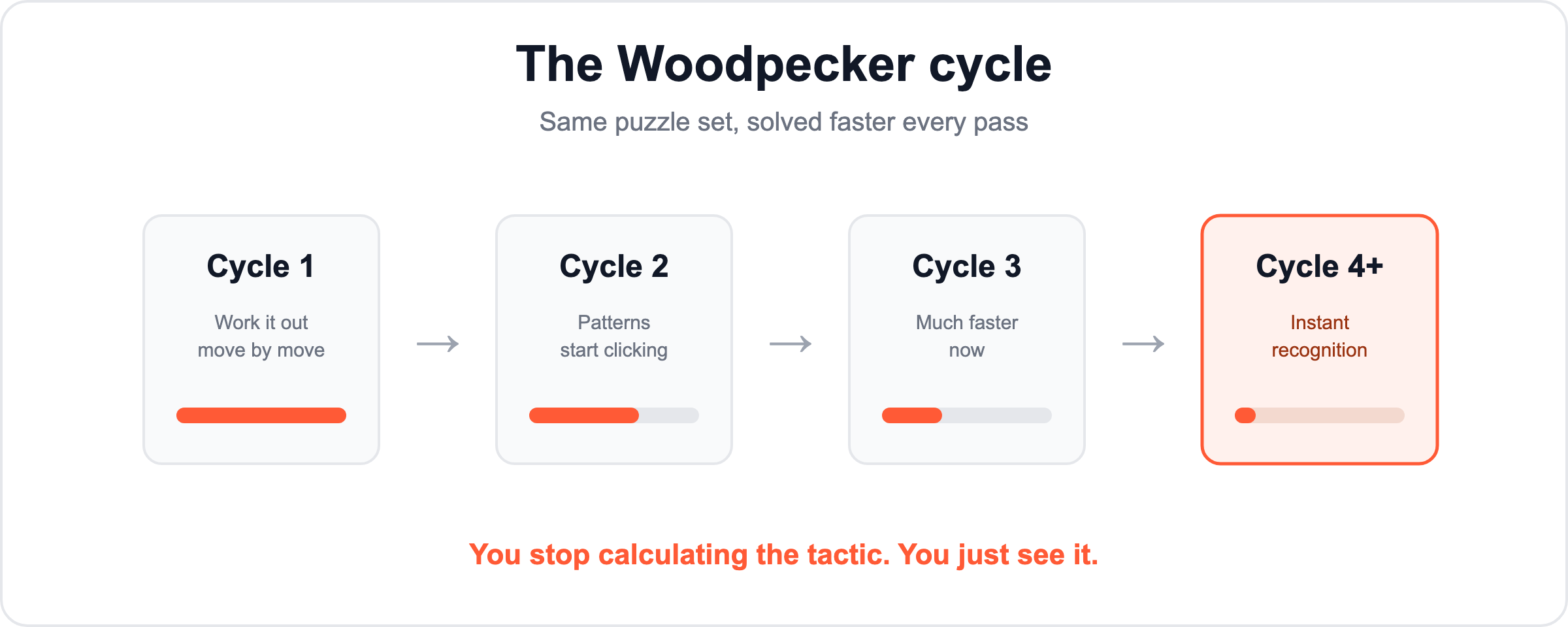
You take a fixed set of tactics, solve every one, and note how long it took. Then you do the whole set again. And again. Each cycle you get faster, because you start recognizing the patterns instead of calculating them from scratch. The name comes from the woodpecker, pecking the same spot repeatedly until it breaks through.
Why it actually works
Most players treat tactics like trivia, something you either know or you do not. But tactics are really about pattern recognition, and pattern recognition is built through repetition, not novelty. When you solve a fresh puzzle once and move on, you might get it in the moment, but you do not burn it into memory. Two weeks later the same pattern shows up in a game and you walk right past it.
Repeating the same set forces the patterns to become automatic. By the third or fourth cycle you are not calculating a knight fork, you just see it, the way you read a word instead of sounding out the letters. That instant recognition is what transfers to real games, where nobody tells you a tactic is there. It is the same reason spaced repetition works so well for chess: you remember what you revisit, not what you see once.
How to actually do it
The original method uses a huge set, over a thousand puzzles, cycled over weeks and halving the time each round. That is a serious commitment and honestly overkill for most players under 1400. You can scale it down and keep the principle. Pick a manageable set, maybe 50 to 100 puzzles at your level. Solve the entire set, no skipping, and note roughly how long it took. After a break, do the same set again and aim to be faster. Repeat the cycle several times over a couple of weeks.
The key rule is same puzzles, not new ones. The whole point is repetition. If you swap in fresh puzzles every session, you are back to trivia mode and the patterns never stick.
The catch, and who it is for
It is tedious. Solving the same puzzles repeatedly is not as fun as fresh ones, which is exactly why most people do not do it, and exactly why it works when you do. It is also not about learning new ideas, it is about making the tactics you already sort of know instant and reliable. If you keep hanging pieces and missing simple forks, that is a recognition-speed problem, and this is the fix.
One honest limitation: a generic puzzle set is calibrated to a rating, not to your actual weaknesses. You can woodpecker a thousand random tactics and still repeat the specific mistakes that lose you games, because those mistakes were never in the set.
The better version: woodpecker your own mistakes
Here is where the idea gets really powerful. The Woodpecker Method is right about the core thing, repetition until recognition is automatic. The only weak point is the puzzle set. So what if the set was not random tactics, but the exact positions where you actually blundered in your own games?
That is the principle behind KingChess. It connects to your Chess.com or Lichess account, finds every spot where you blundered or missed a tactic, and turns each one into a puzzle. Then it brings those puzzles back on a spaced repetition schedule, the same repetition principle as the Woodpecker Method, so you keep seeing your own mistakes until they become automatic. You are not woodpeckering random puzzles, you are woodpeckering the exact patterns costing you rating.
If the Woodpecker Method appeals to you but doing it with generic puzzles sounds like a slog, this is the targeted version. You can try KingChess free at kingchess.io, no signup needed, and drill your own recurring mistakes until they stop.
Woodpecker your own blunders
KingChess turns your real mistakes from Chess.com or Lichess into puzzles and drills them with spaced repetition until the pattern sticks. Free, no signup needed.
Try KingChess free