
Chess Improvement
How Often Do You Play a Cheater on Chess.com and Lichess?
Published
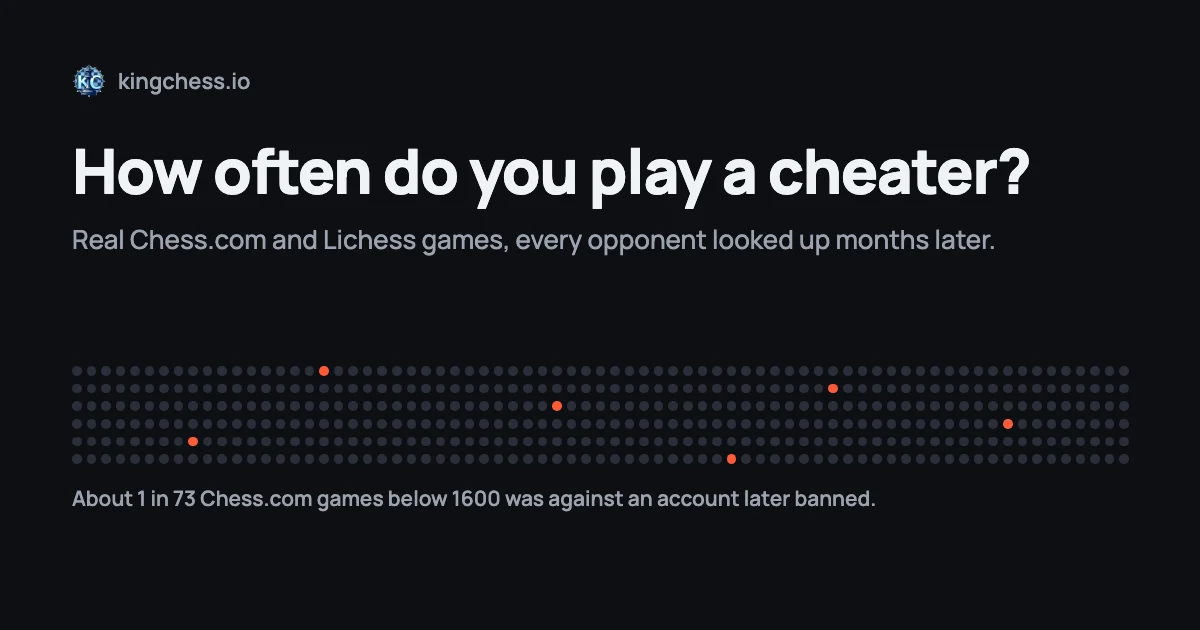
Short answer: On Chess.com, about 1 in 73 games below 1600 was against an account later closed for fair play violations, and 1 in 26 at 2400 and up. On Lichess it was about 1 in 120, counting accounts later marked for breaking its terms. Even against those accounts, the honest player lost only about half the games.
You lose a game to someone who never seemed to miss. Were they cheating? It is a common question, and a hard one to answer from a single game. So we counted instead.
We took real games from July 2026, then looked up every opponent's account months later, on October 30, 2026 for Chess.com and October 31, 2026 for Lichess. That gave both sites time to catch the cheaters among them. Every figure below is from the side of a player whose own account is still open and unmarked.
How often you play a cheater on Chess.com
We sampled 3,002 Chess.com players and took their rated games from July 2026, 266,439 games in all. We picked players so every rating band holds about the same number of games, and took at most 100 games from any one player. A cheater here is an account Chess.com has since closed for fair play violations, its own label for cheating.
| Rating | Bullet | Blitz | Rapid |
|---|---|---|---|
| 400 to 599 | 1 in 771.3% of games | 1 in 801.3% of games | 1 in 551.8% of games |
| 600 to 799 | 1 in 791.3% of games | 1 in 991.0% of games | 1 in 551.8% of games |
| 800 to 999 | 1 in 751.3% of games | 1 in 831.2% of games | 1 in 681.5% of games |
| 1000 to 1199 | 1 in 751.3% of games | 1 in 1100.9% of games | 1 in 601.7% of games |
| 1200 to 1399 | 1 in 831.2% of games | 1 in 1100.9% of games | 1 in 561.8% of games |
| 1400 to 1599 | 1 in 721.4% of games | 1 in 711.4% of games | 1 in 651.5% of games |
| 1600 to 1799 | 1 in 561.8% of games | 1 in 661.5% of games | 1 in 581.7% of games |
| 1800 to 1999 | 1 in 631.6% of games | 1 in 691.4% of games | 1 in 472.1% of games |
| 2000 to 2199 | 1 in 521.9% of games | 1 in 492.0% of games | 1 in 333.0% of games |
| 2200 to 2399 | 1 in 422.4% of games | 1 in 551.8% of games | 1 in 176.0% of games |
| 2400 and up | 1 in 293.4% of games | 1 in 402.5% of games | 1 in 147.0% of games |
A band marked "too few games" had fewer than 2,000 in our sample. Ratings are Chess.com's own. At 2400 and up the pool of players is small, and a few banned accounts played many of that row's games.
How often you play a cheater on Lichess
Lichess publishes every rated game. We took a random sample of 65,000 games played on July 1, 2026 and looked up every player in them. Each game counts once for each player whose own account is still open and unmarked, 125,847 in all. A cheater here is an open account that Lichess has marked for breaking its terms of service.
| Rating | Bullet | Blitz | Rapid |
|---|---|---|---|
| 800 to 999 | too few games | 1 in 1100.9% of games | too few games |
| 1000 to 1199 | 1 in 1300.8% of games | 1 in 961.0% of games | 1 in 531.9% of games |
| 1200 to 1399 | 1 in 1400.7% of games | 1 in 1500.7% of games | 1 in 911.1% of games |
| 1400 to 1599 | 1 in 1200.8% of games | 1 in 1300.8% of games | 1 in 771.3% of games |
| 1600 to 1799 | 1 in 1600.6% of games | 1 in 1900.5% of games | 1 in 901.1% of games |
| 1800 to 1999 | 1 in 1900.5% of games | 1 in 1100.9% of games | 1 in 661.5% of games |
| 2000 to 2199 | 1 in 1300.8% of games | 1 in 1100.9% of games | too few games |
| 2200 to 2399 | 1 in 1100.9% of games | too few games | too few games |
| 2400 and up | 1 in 1500.7% of games | too few games | too few games |
A band marked "too few games" had fewer than 2,000 in our sample. Lichess ratings run on their own scale, usually higher than Chess.com's for the same player, so compare rows within one table, not across the two.
How many of your losses were to a cheater?
The other way to ask it: of the games you lost, how many were to a cheater? Below 1600, 1.5% of the losses of honest Chess.com players came against an account later banned. On Lichess it was 0.9%.
| Site and rating | Share of losses | Lost against one | Lost against anyone |
|---|---|---|---|
| Chess.com, 400 to 1599 | 1.5% | 52% | 48% |
| Chess.com, 1600 to 2199 | 2.3% | 55% | 46% |
| Chess.com, 2200 and up | 4.4% | 49% | 43% |
| Lichess, 400 to 1599 | 0.9% | 48% | 49% |
| Lichess, 1600 to 2199 | 0.8% | 51% | 48% |
| Lichess, 2200 and up | 1.2% | 54% | 44% |
Every time control together. "Share of losses" is how many of the honest player's losses came against an account later banned. "Lost against one" is how many games against such an account the honest player lost. "Lost against anyone" is the same for every game, to compare.
Why the real number is probably higher
Bans keep coming after the games are played. We looked up every account about four months after these games, and some accounts still open that day will be closed later.
Some cheaters also close their own account before a ban comes. We count those as closed, never as cheaters, since we can't tell them apart from anyone else who left. On Chess.com below 1600, another 0.7% of games were against an account closed for some other reason, or gone. On Lichess below 1600 it was 1.5%. If even some of those were cheaters, the real numbers are higher.
A ban does not mean that game was cheated
An account closed for cheating did not have to cheat in every game. Both sites also flag more than engine use. Chess.com's fair play policy bans outside help, sharing an account, and manipulating ratings or game outcomes. The Lichess mark covers engine use and boosting, which is manipulating ratings.
In our sample, the honest player lost 52% of games against a later-banned Chess.com account below 1600, and 48% of all their games. On Lichess it was 48% against 49%. So one loss to a later-banned account does not show the game was cheated, and a win against one is common.
Did you play one? Check your own games
The free cheater check runs the same lookup on your last 500 games. Type your Chess.com or Lichess username and it lists the opponents later banned, with links to your games against them. It also counts the losses that came down to the board.
See what decided your other losses
KingChess finds the moves that cost you games on Chess.com or Lichess and drills them until the pattern sticks. Free, no signup needed.
Try KingChess freeFrequently asked questions
How often do you play a cheater on Chess.com?
In our sample of July 2026 games, about 1 in 73 games below 1600 was against an account Chess.com later closed for fair play violations. At 2400 and up it was 1 in 26.
How often do you play a cheater on Lichess?
About 1 in 120 games from July 1, 2026 was against an account Lichess later marked for breaking its terms. It was 1 in 110 below 1600, 1 in 130 from 1600 to 2199, and 1 in 100 at 2200 and up.
Are there more cheaters at higher ratings?
On Chess.com, yes. Games against a later-banned account went from 1 in 73 below 1600 to 1 in 53 from 1600 to 2199, and 1 in 26 at 2200 and up. On Lichess the rate barely moved: 1 in 110, 1 in 130 and 1 in 100 in the same three groups.
Is cheating more common in rapid, blitz or bullet?
Rapid had the most on both sites. On Lichess, 1 in 69 rapid games was against a marked account, against 1 in 130 in blitz and 1 in 140 in bullet. On Chess.com below 1600 it was 1 in 59 in rapid, 1 in 89 in blitz and 1 in 77 in bullet.
How many of my losses were to cheaters?
Below 1600, 1.5% of losses on Chess.com and 0.9% on Lichess came against an account later banned. The share was higher at 2200 and up: 4.4% on Chess.com and 1.2% on Lichess.
If my opponent was banned, was our game cheated?
Not necessarily. Both sites flag more than engine use, and an account can cheat in some games and not others. Below 1600, honest players lost 52% of their games against later-banned Chess.com accounts, and 48% of all their games.
How can I check if I played a cheater?
The free cheater check looks up the opponents in your last 500 Chess.com or Lichess games and lists the ones later banned, with links to your games against them.